In the competitive landscape of American higher education, the ability to construct a compelling argument is often viewed as a fundamental academic requirement. From the Ivy League lecture halls to state university seminars, students spend countless hours refining their thesis statements and sourcing credible evidence. However, the true value of this skill extends far beyond the confines of a grading rubric. Argumentative writing is, at its core, the laboratory of leadership.
Effective leadership in the 21st century requires more than just charisma; it demands the intellectual rigor to synthesize complex information and present it persuasively. For many students navigating these high standards, engaging an Argumentative Essay Writing Service in the USA provides a foundational understanding of how to structure logical defenses and address counter-arguments. This professional guidance ensures that the transition from academic theory to real-world application is seamless, fostering the critical thinking necessary for executive decision-making.
The marketplace today is driven by data and the interpretation thereof. Whether a professional is acting as an economics essay writer for a research firm or pitching a new tech startup in Silicon Valley, the ability to weave data into a narrative is paramount. To bridge the gap effectively, one might look to an economics essay writer to understand how quantitative trends are translated into qualitative arguments. This skill set—integrating narrative and argumentative modes—is exactly what separates a mid-level manager from a visionary leader.
The Leadership Writing Framework: Mastering Critical Thinking Subskills
Modern leadership assessment models prioritize specific cognitive subskills that are honed through rigorous writing. By focusing on these areas, students transition from passive learners to active influencers.
1. Evidence Evaluation and Synthesis
Leaders must determine which data points are “signals” and which are “noise.” Argumentative writing mandates the Evidence Evaluation process, requiring writers to vet sources for bias, recency, and relevance—a direct precursor to strategic market analysis.
2. Rebuttal Framing and Risk Mitigation
A thesis is only as strong as its defense. In leadership, Rebuttal Framing involves anticipating stakeholder objections or market shifts. By addressing these “counter-arguments” in a draft, a future executive learns to build “bulletproof” business strategies.
3. Logical Warrants and Strategic Warrants
Using the Toulmin Model, writers connect evidence to claims via “warrants”. In the boardroom, this translates to the underlying logic that justifies a multi-million dollar investment based on current consumer trends.
Case Study: The MDM Strategy in Action
Recent research into Multi-Discourse Mode (MDM) suggests that combining narrative storytelling with hard argumentation yields the highest engagement. Consider “Alex,” an MBA student who struggled to secure funding for a sustainable tech venture.
Alex initially presented a purely data-driven argument. While the logic was sound, it lacked emotional buy-in. By applying MDM strategies—weaving the narrative of the community impact alongside the argumentative proof of ROI—Alex was able to appeal to both the logic and the values of the venture capitalists. This transition from “writer” to “advocator” is the hallmark of modern leadership.
The Psychology of Persuasion in American Corporate Culture
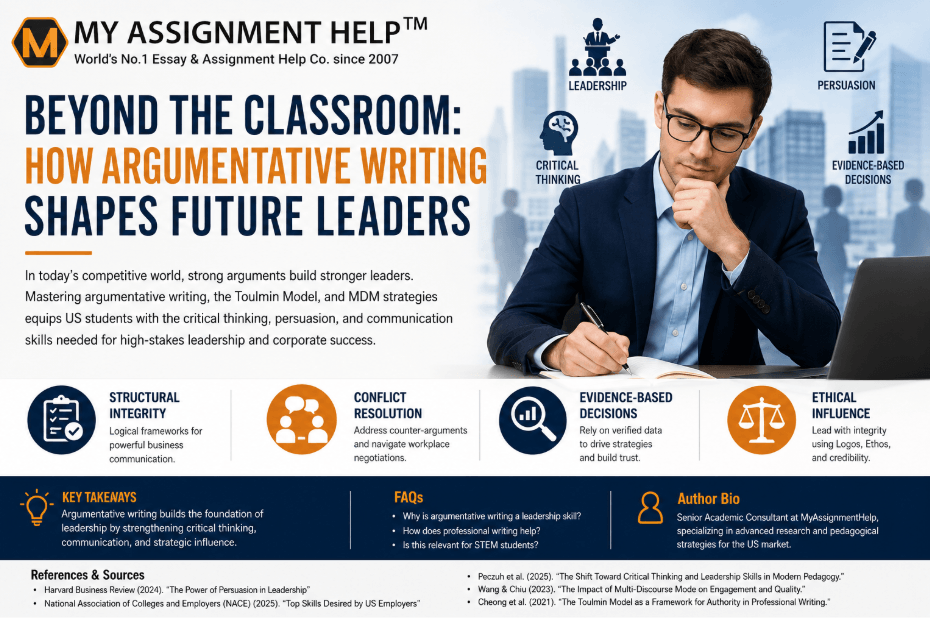
In the United States, corporate culture is built on the concept of the “marketplace of ideas”. Leaders are expected to defend their strategies against intense scrutiny from stakeholders, boards, and competitors. Argumentative writing teaches students the Toulmin Model—claims, grounds, warrants, and rebuttals—which serves as the blueprint for every successful business proposal. When a CEO defends a pivot in company strategy, they are essentially delivering a high-stakes argumentative essay.
Key Takeaways
- Structural Integrity: Argumentative writing provides the logical framework for strategic business communication.
- Conflict Resolution: Learning to address counter-arguments in writing prepares leaders for workplace negotiations.
- Evidence-Based Decisions: It mandates a reliance on verified data over personal bias.
- Ethical Influence: It encourages the use of Logos and Ethos to lead teams without coercion.
See also: The Real Cost and Access Tradeoffs Behind TB 500 BPC 157
FAQs: Professional Writing and Leadership Development
1. Why is argumentative writing considered a leadership skill?
It teaches the ability to organize thoughts logically, support claims with evidence, and anticipate challenges—all of which are essential for strategic planning.
2. How does professional writing assistance help in developing these skills?
By reviewing professionally structured arguments, students learn the nuances of tone and evidence integration that are standard in US professional environments.
3. Is this relevant for STEM students?
Absolutely. Scientists and engineers must argue for the validity of their research to secure funding and drive technical adoption.
Author Bio
Kara Betty is a Senior Academic Consultant at MyAssignmentHelp, specializing in advanced research and pedagogical strategies for the US market. With an emphasis on the intersection of academic rhetoric and executive leadership, they help students master the methodologies required for long-term professional success.
References & Sources:
- Harvard Business Review (2024). “The Power of Persuasion in Leadership”.
- National Association of Colleges and Employers (NACE) (2025). “Top Skills Desired by US Employers”.
- Peczuh et al. (2025). “The Shift Toward Critical Thinking and Leadership Skills in Modern Pedagogy.”
- Wang & Chiu (2023). “The Impact of Multi-Discourse Mode on Engagement and Quality.”
- Cheong et al. (2021). “The Toulmin Model as a Framework for Authority in Professional Writing.”