A dining table looks simple from the outside. A flat top. Four legs. Maybe six. Some wood, some glass, some metal. You pull up chairs and eat on this piece of furniture.
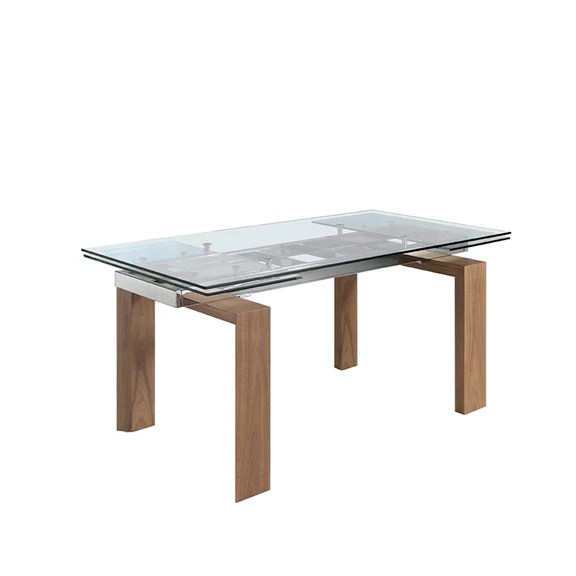
The best extendable dining table is a different animal. Somewhere under that flat top sits a mechanism that has to do three things at once. Hold the weight of a full dinner service without flexing. Slide open smoothly enough that one person can manage it. Close back without leaving a visible seam down the middle of the surface.
Most people never think about this until the moment the table fails them. That is when the engineering stops being invisible.
What actually sits under the tabletop
The best extendable dining table relies on four separate systems working together:
- The runner. The sliding rail under the table that lets the top split apart. Cheap versions use stamped steel with plastic bushings. Quality versions use precision-ground steel rails with ball bearings.
- The synchronizer. A gear or linkage system that makes both halves of the table move at equal rates when pulled. Without it, one side drags, and the alignment goes off.
- The leaf storage. On self-storing models, a mechanism lifts the hidden leaf from inside the table and locks it into position. This is the part that fails most often in low-quality builds.
- The alignment pins. Small steel dowels that guide the leaf into the perfect position. Worn or plastic versions leave the seam visible.
None of this shows in a catalog photograph. You only know the difference when you open the table a hundred times over five years.
The fear most buyers carry into the showroom
There is a fear sitting behind most dining table purchases in Ghana. The piece looks beautiful in the first year. By year three, it has started to show problems you cannot fix without calling a carpenter and explaining mechanisms he has never worked with before. Imported pieces often lose their warranty support the moment they leave the country of origin. You are stuck.
This is where the European manufacturers carried at Dellino separate themselves.
Angel Cerda, the Spanish furniture house that supplies the bulk of the Dellino furniture range, builds extendable tables with the mechanism treated as a proper engineering component rather than an afterthought. The runners are aluminum-reinforced steel. The synchronizers are geared. The leaves are stored inside the table on many models rather than requiring external storage.
See also: After the Blockage Report: How Doctors Decide Between
What to check before you commit
A few things worth knowing when specifying an extendable table at this level:
- The top material affects how the mechanism behaves. Solid wood expands and contracts with humidity, which matters in Accra. Engineered tops with veneer faces hold their dimensional stability better over the years.
- Ceramic and sintered stone tops add significant weight, which changes the runner specification. Make sure the mechanism is rated for the top.
- Check the seam quality on the extended surface. A good table shows a seam you can feel with your fingernail but not see with your eye.
- Ask about the closed and extended dimensions in the same conversation. The gap between the two tells you how many people the table genuinely seats rather than the marketing number.
Price points across the Angel Cerda extendable range at Dellino run from around EUR 1,800 for entry configurations up to above EUR 4,000 for larger statement pieces with walnut, steel, or marble tops. The brand ships with ISO 9001 certification and a full manufacturer’s warranty, which is the base standard for any furniture meant to last a decade or longer.
Why the mechanism matters over ten years
Perhaps the quiet argument for buying this class of extendable table is one most buyers do not hear until after they have bought a cheap one first.
The table is one of the hardest-working pieces of furniture in a home. Every meal. Every homework session. Every time someone sits down with a laptop for the afternoon. The extension mechanism gets a workout every time the house hosts more than the usual number. Over ten years, a mechanism opens and closes hundreds of times.
A mechanism built to engineering standards does not notice that use. A cheap one does not survive it.
The frustration of an extendable table that has stopped extending smoothly is specific. You stand at one end. Someone stands at the other. You both pull. Nothing moves, or something moves awkwardly, and the guests watching you pretend not to notice while you wrestle with it.
This is the result that is completely preventable.
Buying with local support behind you
Indeed, Dellino is the only representative of Africa for the company Angel Cerda, and this ensures that all components come to Accra with complete specifications from the factory, along with local warranties, instead of emailing from different countries of the world. You can visit our showroom, manipulate the machinery by yourself, and decide on the configuration that is best suited to you.
No guessing from a website image. No surprise at delivery.
A good extendable table works like the quiet engine of a well-designed car. You stop thinking about how it works. You just use it.
Visit the Dellino showroom in Accra to see the Angel Cerda extendable dining range in person.